Press
As of November 8, 2026 · LehrPuls 1.21.1
Everything on this page may be used for articles, newsletters, tool directories and talks: texts in three lengths, a fact sheet, six screenshots from the real application, the logo package and a quote. Questions and interview requests: office@lehrpuls.com.
Boilerplate
One sentence (about 50 words)
LehrPuls is a classroom response tool for lectures and seminars that runs on the instructor's laptop: students answer in their smartphone browser, the result grows live on the projector, and the analytics show across semesters what lands — no account, no cloud, a one-time license for Windows and macOS.
Short (about 150 words)
Do instructors know whether what they explained has landed? LehrPuls answers that question in twenty seconds. The instructor asks a question, students scan a QR code and answer on their own smartphones, and the result appears on the projector. Unlike the usual web services, LehrPuls runs entirely on the instructor's laptop: there are no accounts, no cloud and no data processor; the data stays in house. For the online path outside the room's Wi-Fi, questions and answers travel end-to-end encrypted through a relay server that sees nothing readable.
Nineteen question types, from multiple choice to numeric answers with tolerance, formula, cloze and sketch, cover engineering as well as the humanities. Peer instruction runs as a two-round flow. The analytics provide difficulty, discrimination and response times per question and track the same question across several semesters. LehrPuls is developed by Dr. Florian Hollomey, an instructor at an Austrian university of applied sciences, and has been available for Windows and macOS since September 2026.
Long (about 400 words)
Whoever stands in front of a lecture hall sees faces, not thoughts. Whether an explanation has landed often only shows in the exam — too late for the course in which it should have worked. LehrPuls brings that feedback into the class: the instructor opens a question, students answer on their own smartphones, and after twenty seconds the distribution is on the wall. The instructor then decides whether to move on or take another run at it.
The difference from well-known services such as Mentimeter or Kahoot! lies in how it is built. LehrPuls is a desktop application for Windows and macOS, and the instructor's laptop is the server. Students' devices connect to it directly via QR code; on the room's Wi-Fi this works without internet access. Nobody creates an account, neither instructors nor students, and there is no cloud where answers would be collected. For lecture halls where computers and Wi-Fi sit in separate networks there is an online path through a relay server: content is end-to-end encrypted there, the key sits in the join address and never reaches the server. An IT guide and a privacy dossier with a DPIA template are available for privacy officers and IT departments.
Didactically, LehrPuls goes beyond polling. Nineteen question types — including numeric answers with tolerance and unit, formula, cloze, matching, ordering, word cloud, image question and sketch — make it as useful for engineering as for languages or medicine. Peer instruction after Eric Mazur is built in as a two-round flow: answer alone first, then discuss, then answer again. Questions can be shown as an overlay on PowerPoint, Keynote or PDF, controlled remotely from a smartphone, and planned in playlists for an entire semester. A question wall, files to everyone and group work — anonymous too — provide communication in both directions.
The developer sees the greatest benefit in the analytics. Every question gets metrics such as difficulty, discrimination and response time; the same question can be compared across semesters, and topics receive a maturity level. Instructors thus learn about their own teaching: which explanation does not hold, which question is too easy, where time runs short. Researchers get a raw-data export and a read-only API; within a team, instructors pass topics and playlists on with the "baton."
LehrPuls is developed by Dr. Florian Hollomey, who teaches at an Austrian university of applied sciences and uses the tool in his own courses. The application has been available since September 2026; the trial version can be used without time limit, and a license for educational institutions costs a one-time €79 per seat, with volume pricing from five seats.
Fact sheet
| Product | LehrPuls — live questions in the lecture hall, local, no cloud |
|---|---|
| Platforms | Windows 10/11 (64-bit), macOS (Universal); participants only need a browser on a smartphone, tablet or laptop |
| First release | Version 1.0 on September 13, 2026; current 1.21.1 of November 6, 2026 |
| Question types | 19, including multiple choice, poll, numeric with tolerance and unit, estimate, formula, cloze, matching, ordering, ranking, scale, word cloud, image question, idea wall, 2×2 grid, sketch |
| Participants | up to 500 per session; anonymous, pseudonym, name, or name and student ID |
| Operation | local on the room's Wi-Fi without internet, or online via the relay, end-to-end encrypted (AES-256-GCM); no account, no cloud, no data processor |
| Teaching | peer instruction in two rounds, overlay on slides, remote control on the smartphone, question wall, groups (anonymous too), playlists with schedule |
| Analytics | difficulty, discrimination, response times per question; longitudinal view across semesters; topic maturity; export to Excel, PDF report, read-only REST API, templates for Power BI, R and Python |
| Team | baton: pass topics, questions and playlists on as a package, by file, email or exchange folder |
| Languages | interface in English and German; questions can be bilingual, further languages via translation files |
| Price | trial without time limit (six participants per session); Education license €79 one-time per seat, €69 from 5 seats, €59 from 25, €49 from 100; Commercial €149 to €89; incl. VAT |
| Technology | Rust and Tauri, Vue and Quasar, SQLite; relay in Rust hosted by Hetzner in the EU; code signing for Windows and macOS |
| Developer | Dr. Florian Hollomey, university instructor; sole proprietorship, Rohr 17, 8413 Ragnitz, Austria |
| Web | lehrpuls.com · office@lehrpuls.com |
Quote
"After five sessions, the analytics showed me that almost half of my questions were too easy. That was the first piece of feedback — and it was about me, not about the students. That is exactly why I built LehrPuls: so that not only the students learn."
Images
Six screenshots from the real application (sample data), free to use with the credit "Image: LehrPuls." Click opens the full-resolution PNG. The interface shown is German; English screenshots are available on request.
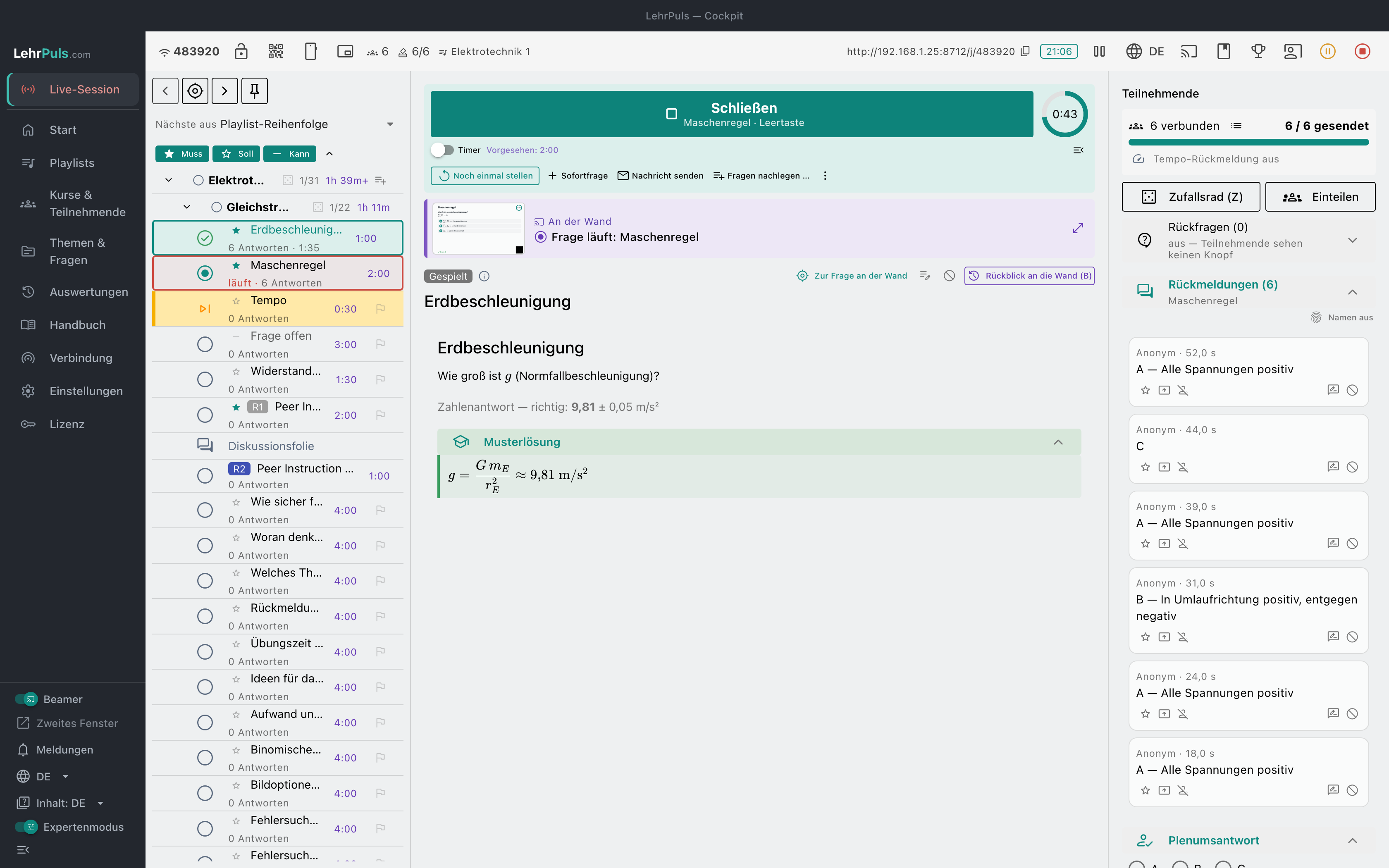
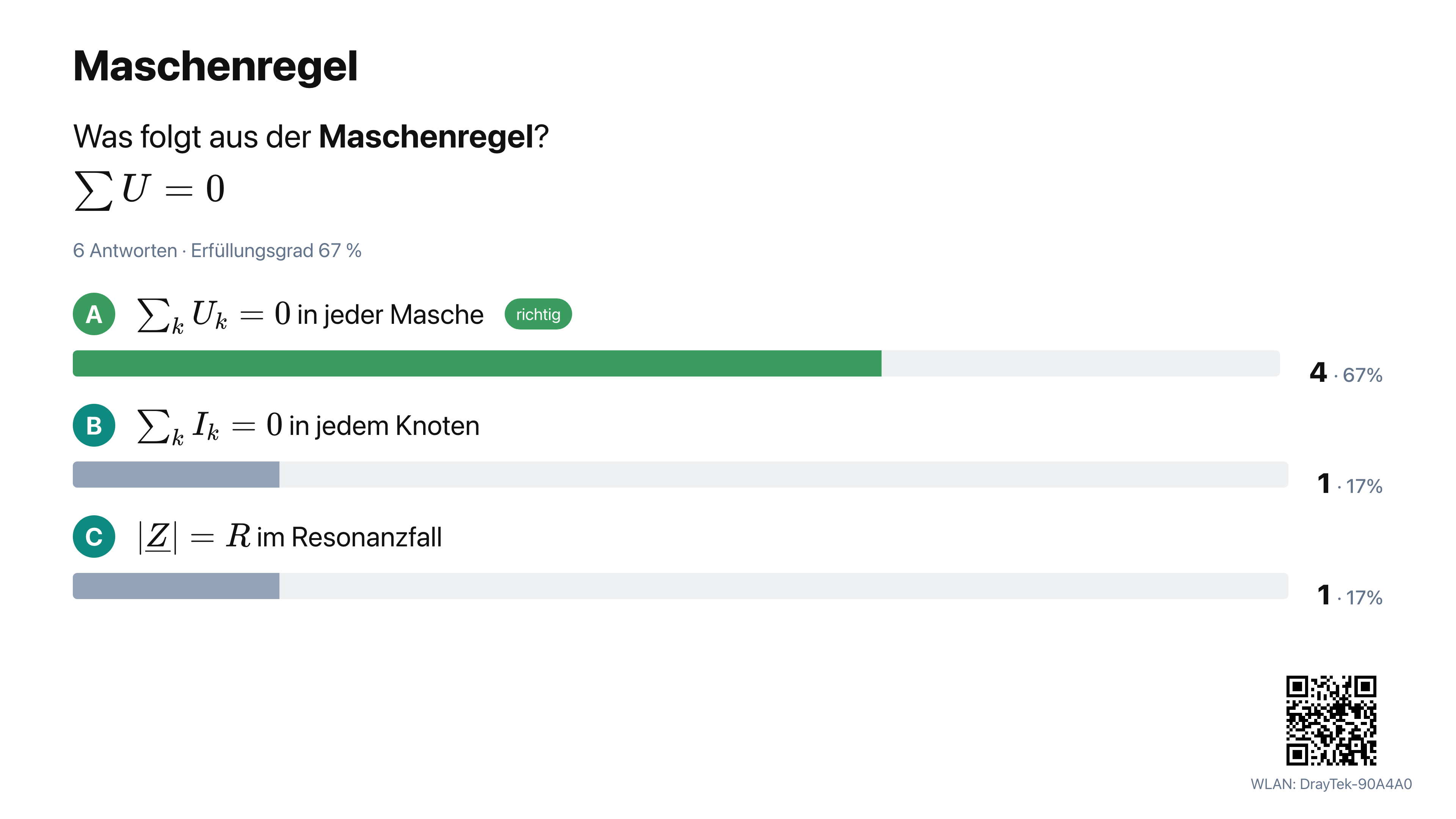
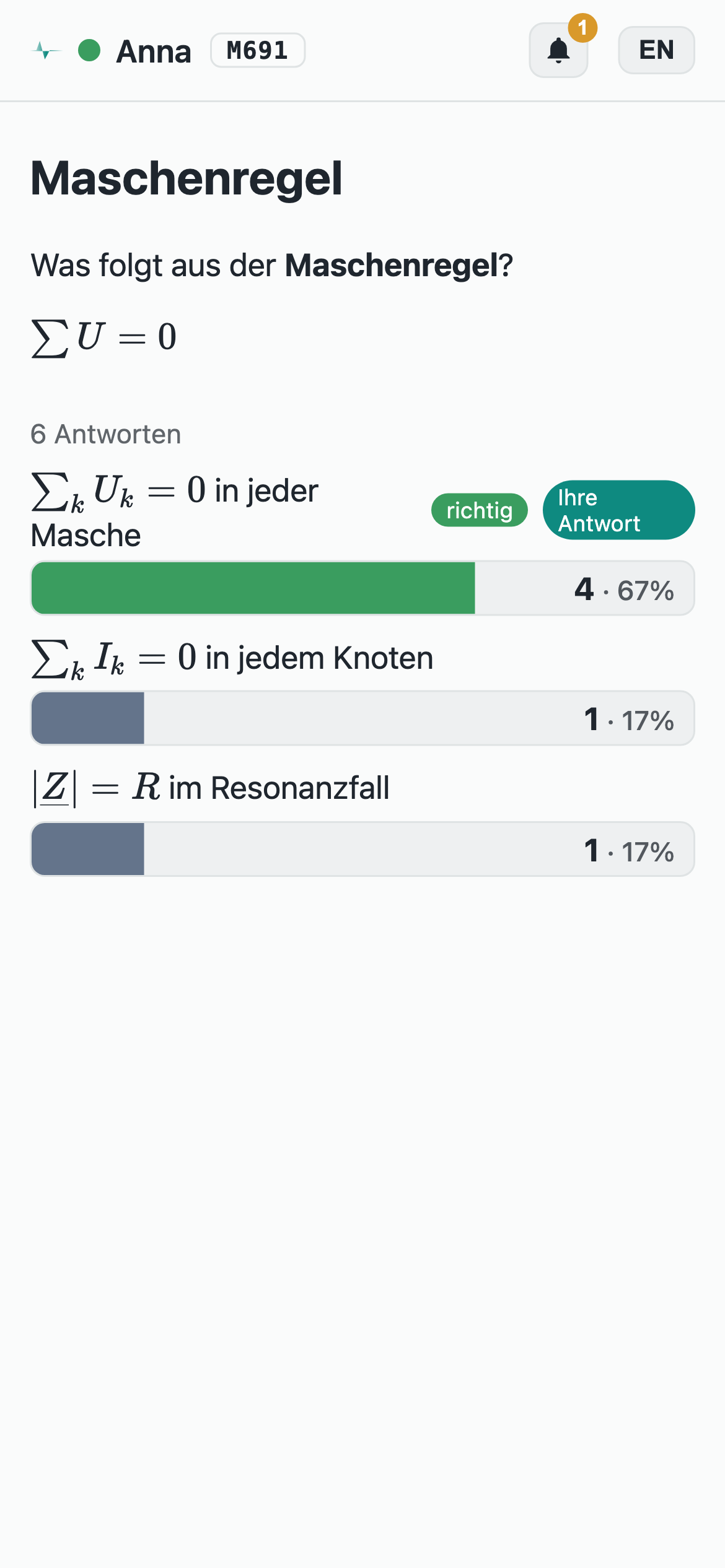
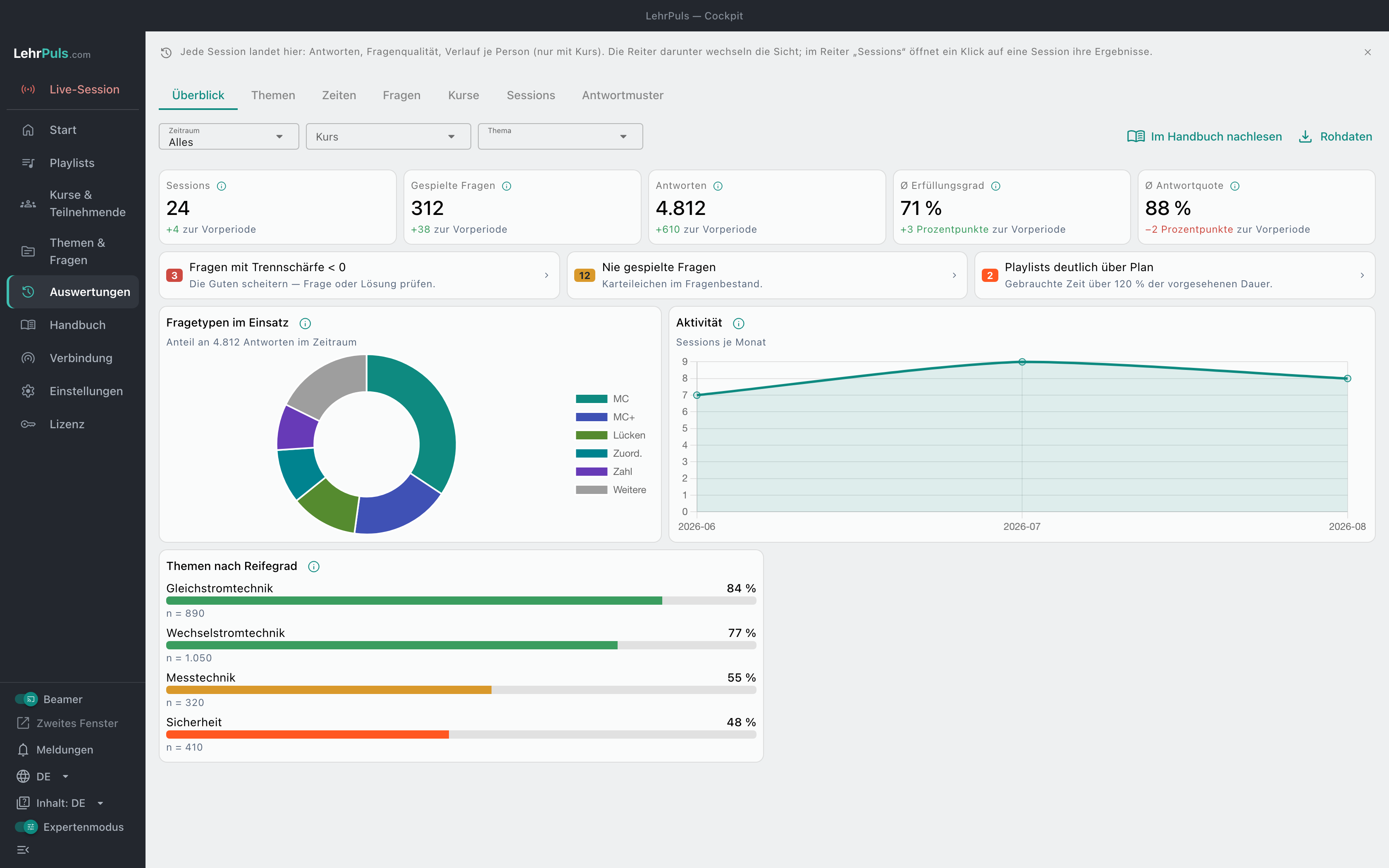
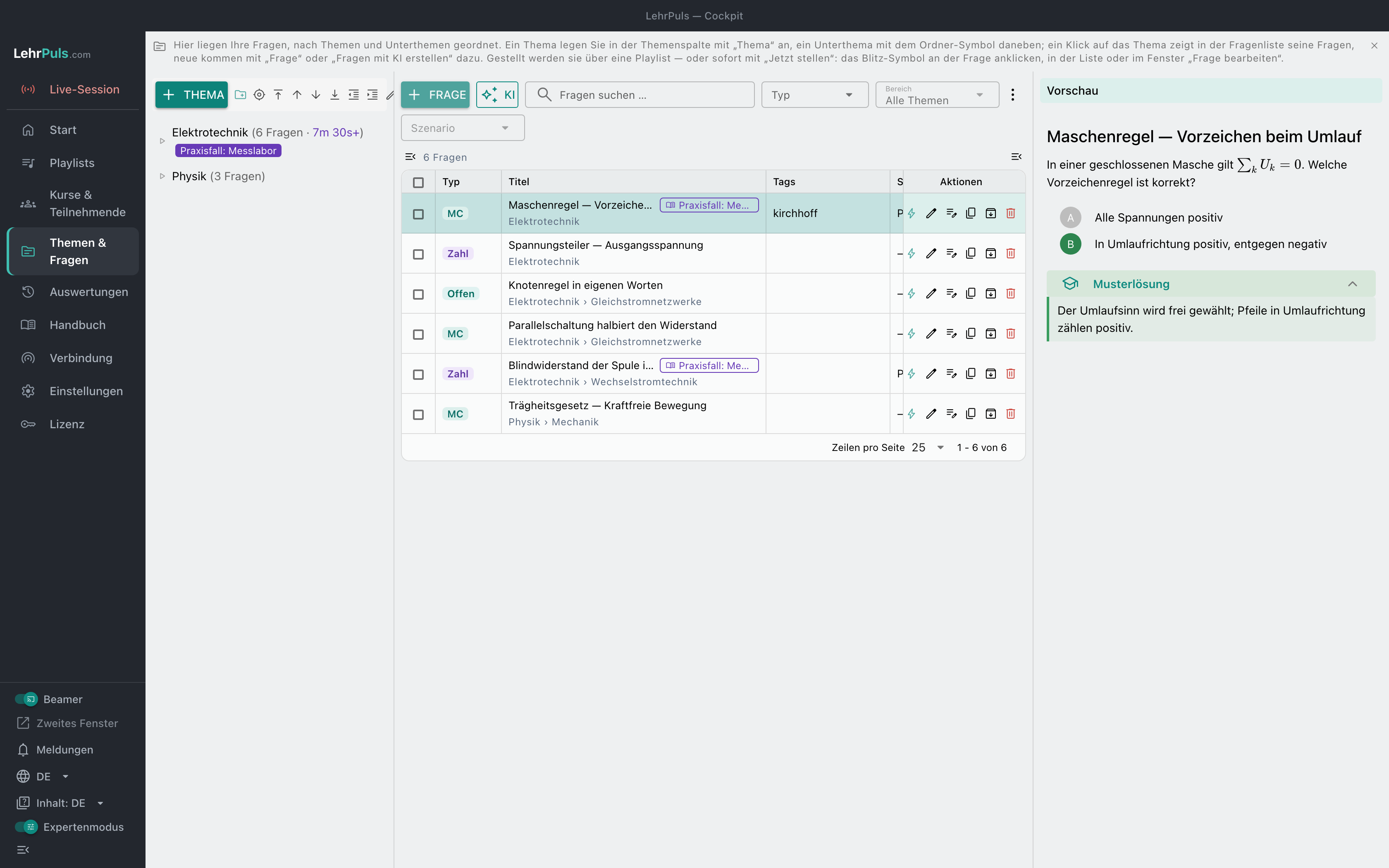
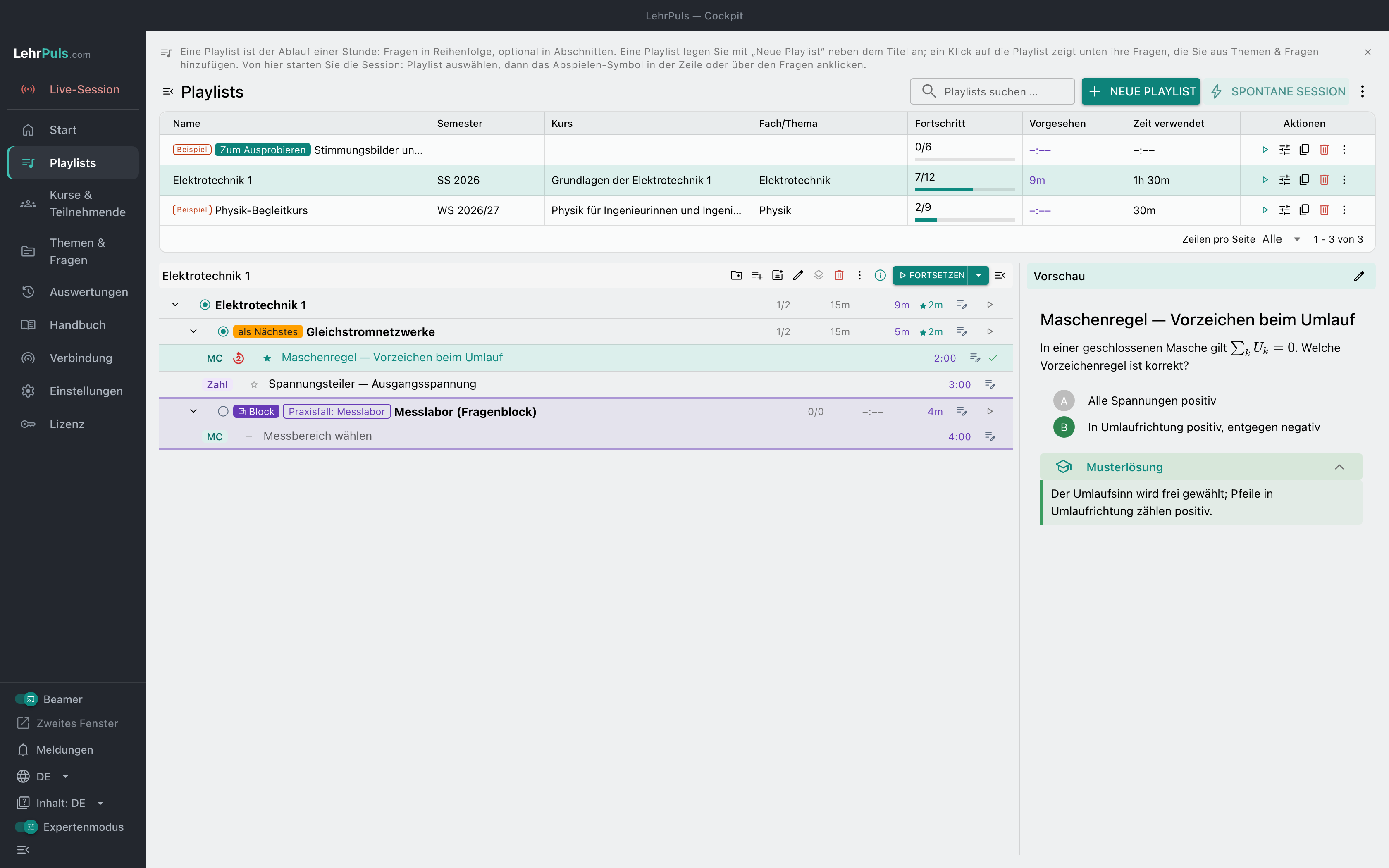
More images with captions: Screenshots. A portrait photo of the developer is sent on request.
Logo
The "pulse and bars" logo and the wordmark may be used in articles about LehrPuls — unchanged, without distortion, not as part of another logo. Download the logo package (SVG, PNG 512 and 192 px, favicon). Colors: petrol #0e8a80, dark petrol #135a56, green #26a69a.