For universities
Flyer "LehrPuls for Universities" (PDF)
Privacy & Security Fact Sheet (PDF)
Live polling in the lecture hall — local, no cloud.
← hollomey.com DeutschLehrPuls makes visible what lands in the lecture hall — for students during the class, for instructors across the semester, for the institution across years. One question, twenty seconds, a distribution on the wall: that is the tool. What it does shows on six levels.
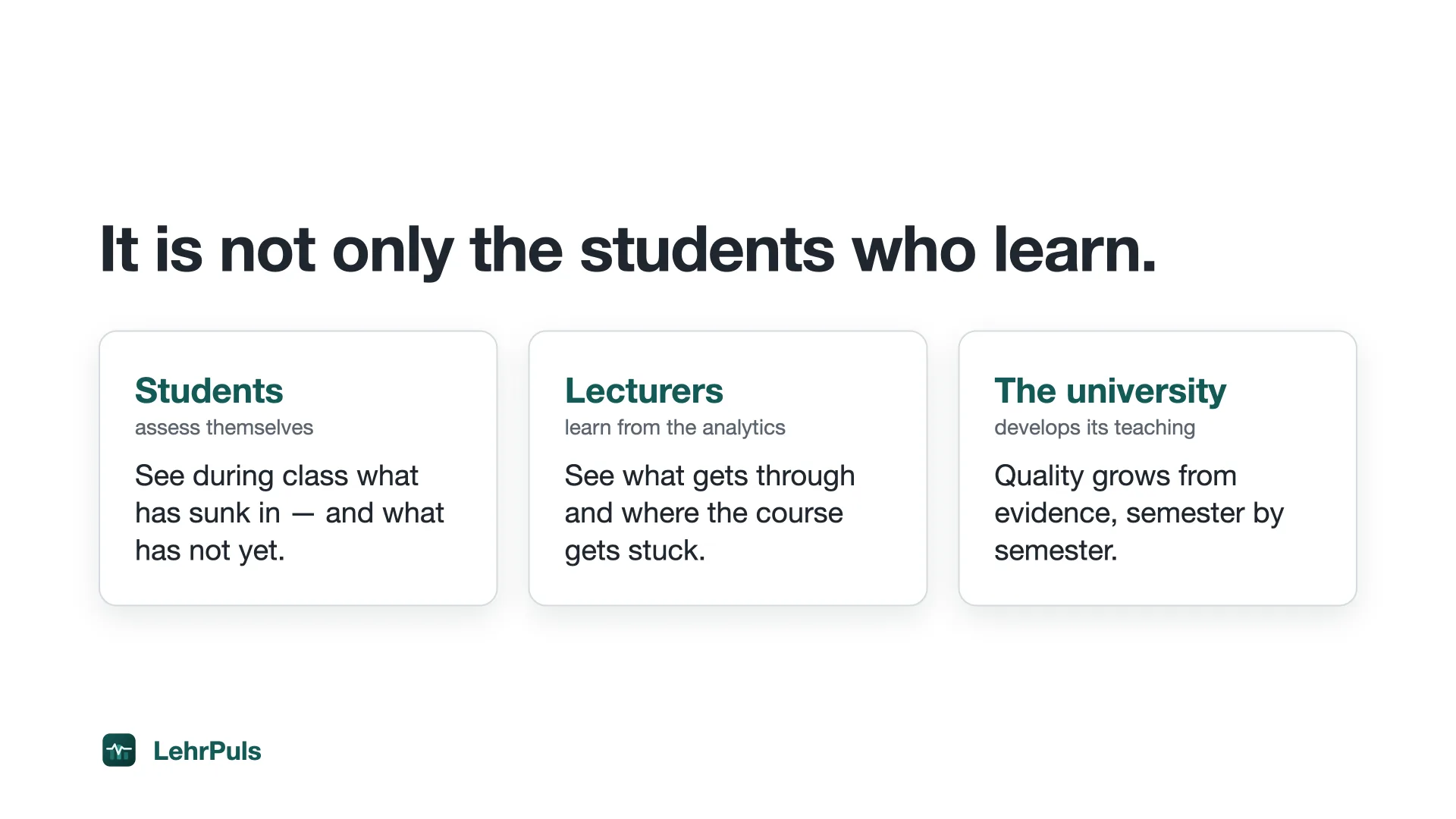
1 · Students
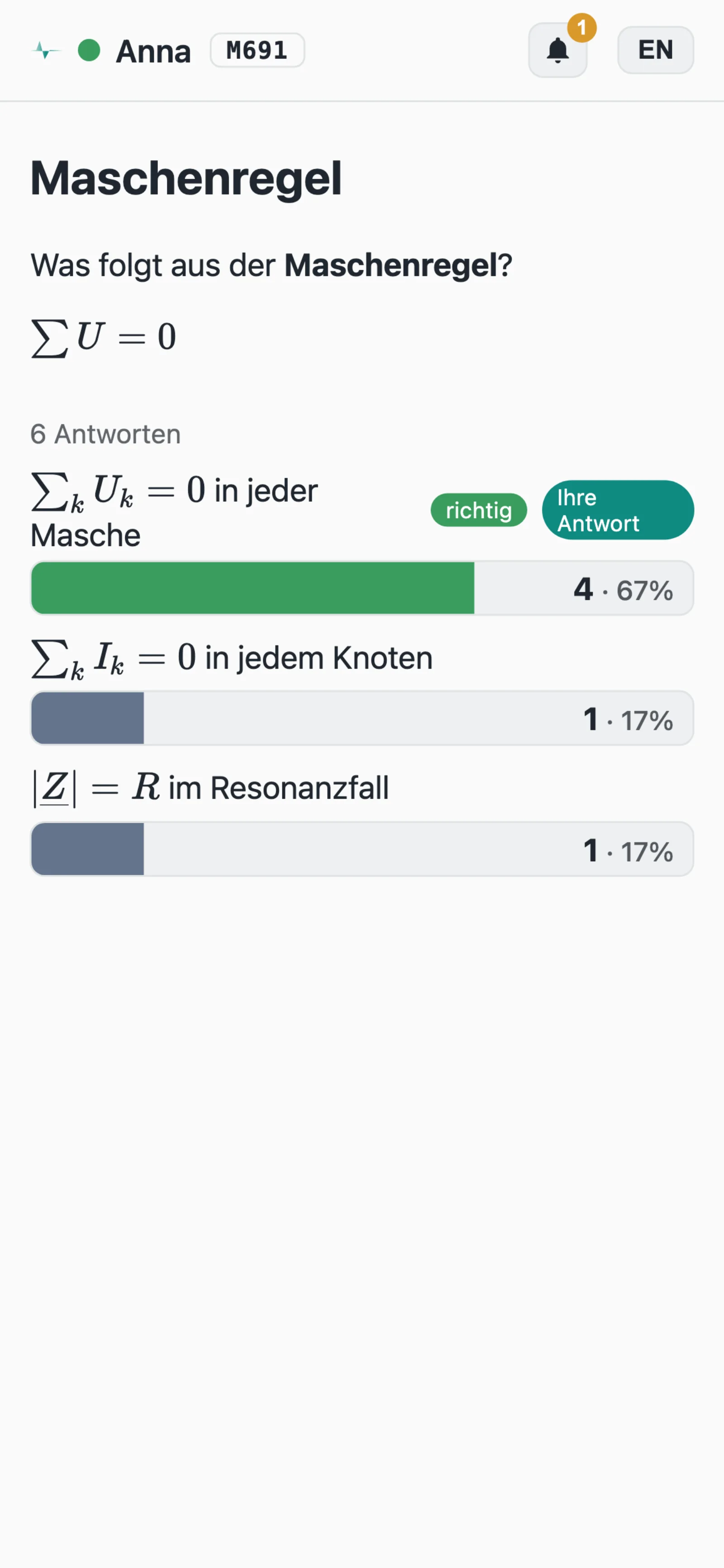
Every question is feedback to the person answering: "I've got this — not that yet." The reveal on their own smartphone shows the correct answer next to their own, anonymously, with no grade and no account. Peer instruction makes the difference between the first and second answer tangible: answer alone first, then discuss with your neighbor, then answer again.
Pedagogical basis: formative assessment, the testing effect and metacognitive calibration — students who are asked regularly and compare their self-assessment with the result demonstrably learn more durably.
2 · Instructors
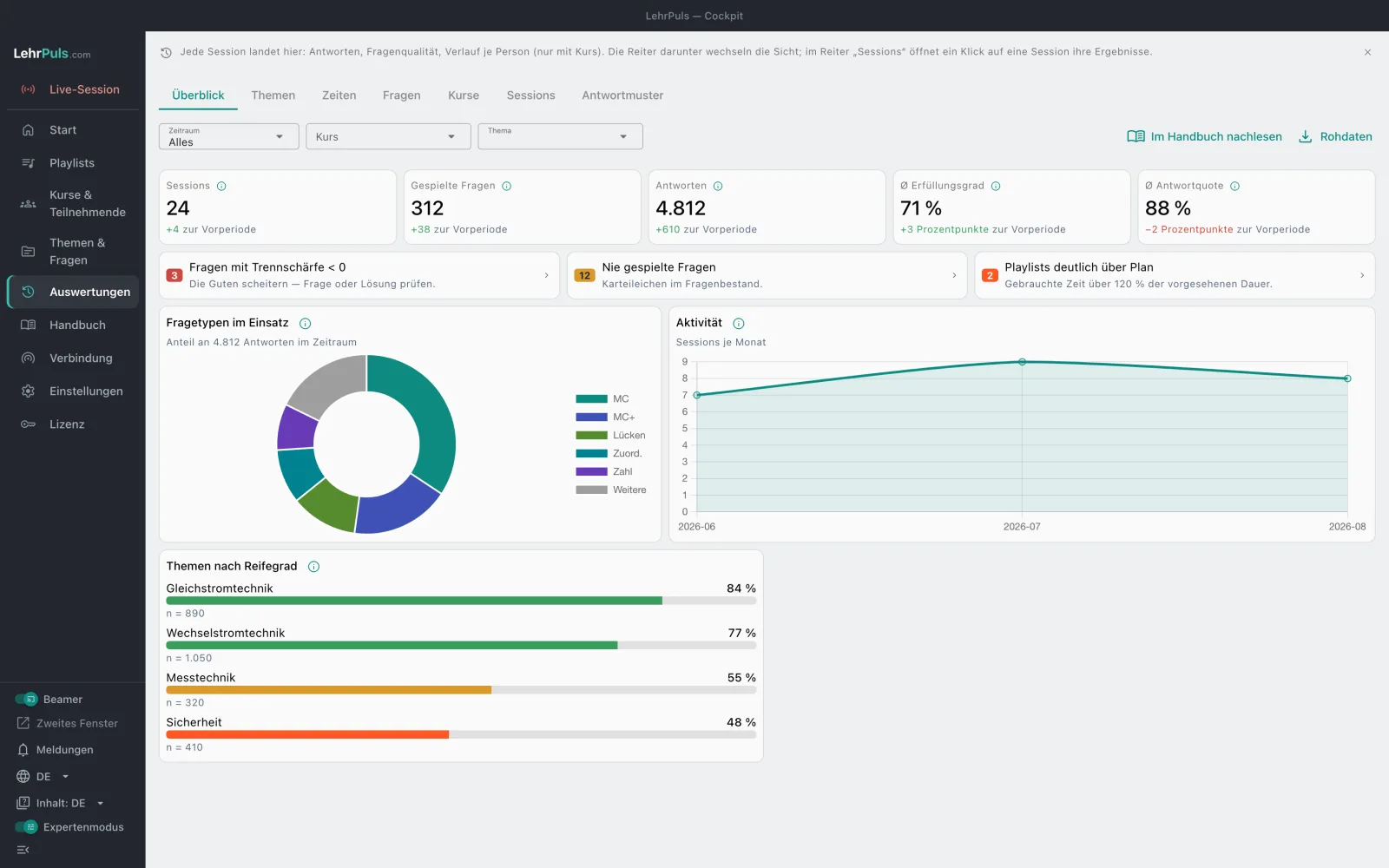
The analytics show not only what students know but where the course stumbles: which explanation does not hold, which question is too easy or unclear, where time runs out. Each question gets difficulty, discrimination and response times; the same question can be compared across semesters, and topics receive a maturity level.
"After five sessions, the analytics showed me that almost half of my questions were too easy. That was the first piece of feedback — and it was about me, not the students."
Pedagogical basis: data-informed teaching and the Scholarship of Teaching and Learning — developing your own teaching from evidence instead of gut feeling.
3 · Research
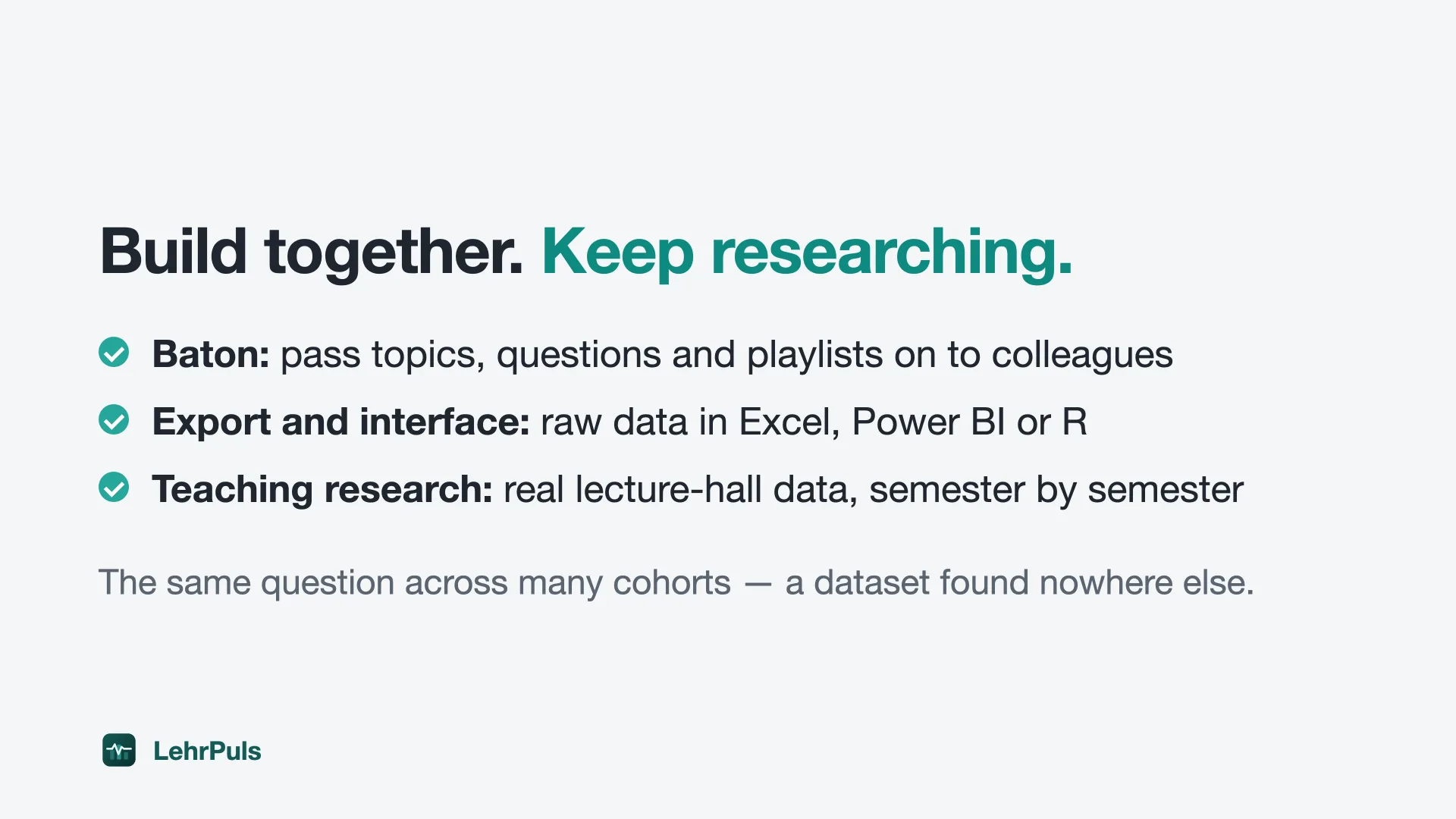
Raw data in long format for Excel and R, metric tables for Power BI, a read-only API with a time-limited key — anonymized by default. The same question across many cohorts yields a data set that does not exist otherwise: peer-instruction gain, response time as a learning indicator, calibration over a semester. The Research Kit describes the data model and the column contract and comes with sample scripts.
Pedagogical basis: educational research with real classroom data — the data belongs to the institution, not to a vendor.
4 · Team
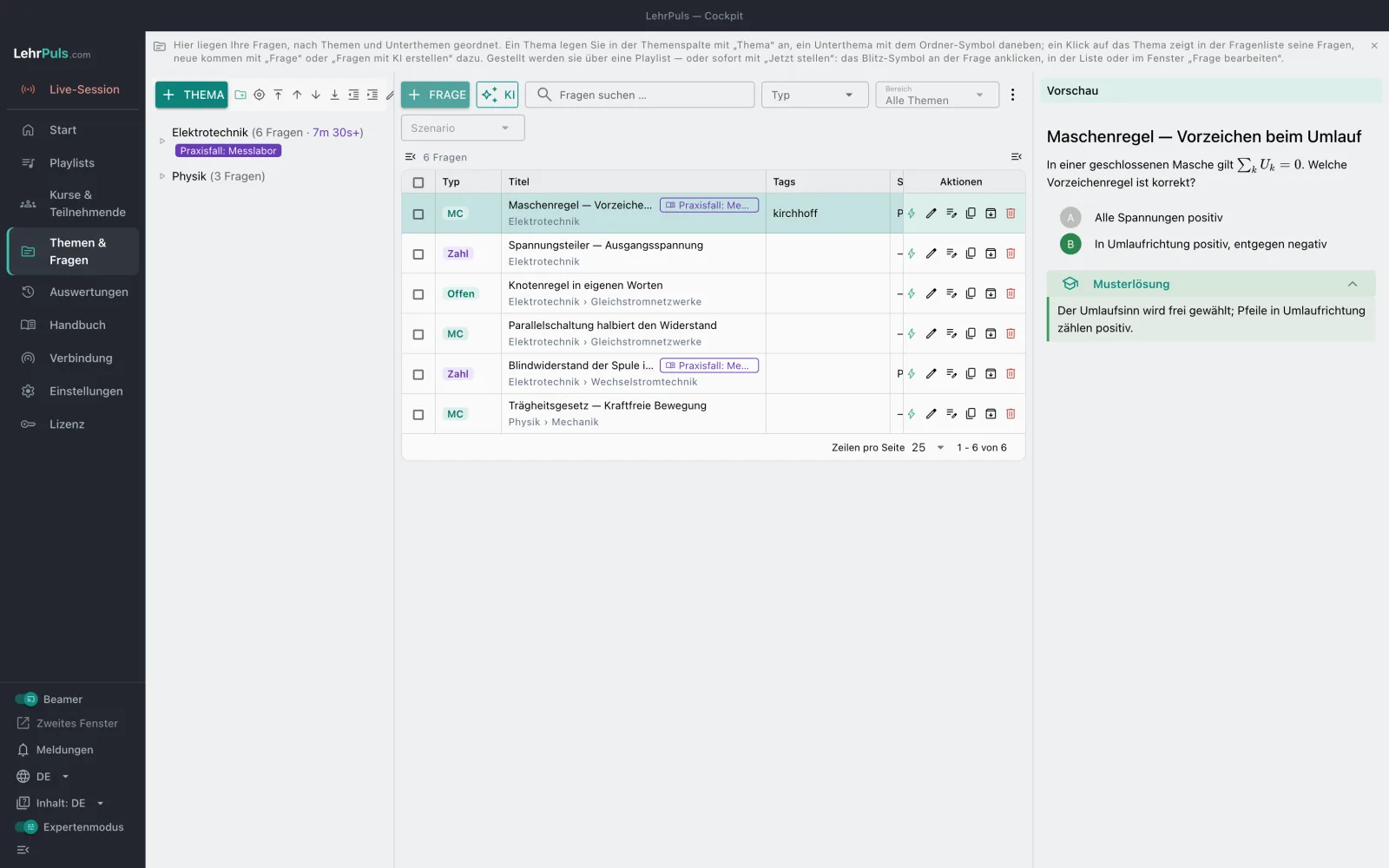
With the baton, instructors pass topics, questions and playlists on as a package — as a file, by email or through a shared exchange folder. Adopt with one click, history visible, read-only copies for everyone who just wants to look. Question banks become the common property of a degree program.
Pedagogical basis: collegial course development — good questions emerge in a team and get better every semester.
5 · Institution
Metrics per topic, course and semester instead of gut feeling: topic maturity, planned versus actual time, course comparison and the same question tracked across semesters, reports and Excel export for program directors and quality management. A topic's maturity appears only from ten answers upward; individuals stay protected. There is no cloud and there are no accounts; data stays in house — privacy becomes an enabler of quality work.
Pedagogical basis: quality development of teaching from aggregated evidence, without exposing individuals.
For teaching centers, quality management, IT and privacy officers: flyer "LehrPuls for Universities" (PDF) and the Privacy & Security Fact Sheet (PDF).
6 · Technology
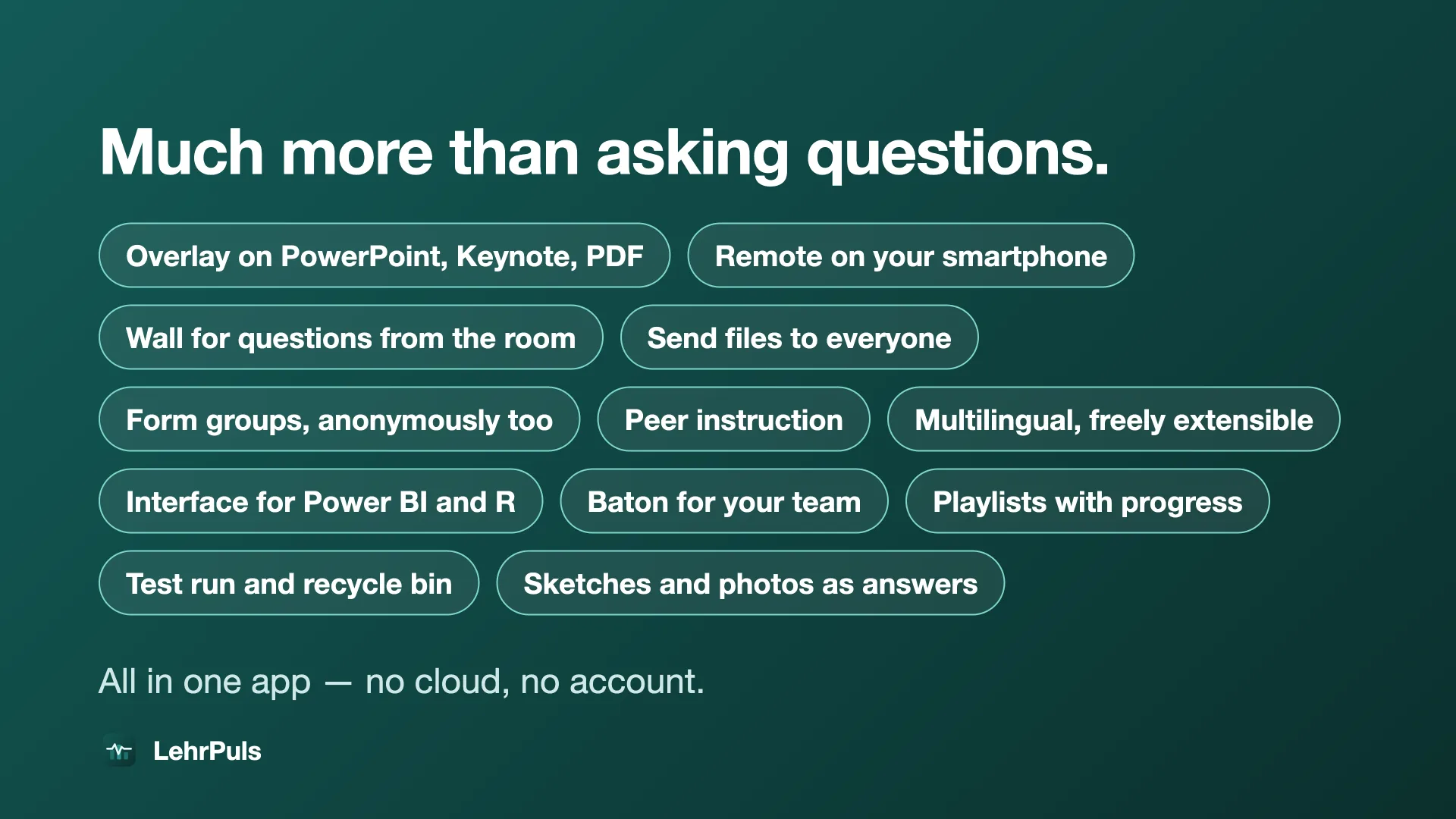
Overlay over PowerPoint, Keynote and PDF; remote control on the smartphone; question wall and files to everyone, so communication runs both ways; groups, anonymous too; multiple languages, extensible at will; an API; a trial run and a trash bin. One app for Mac and Windows, a one-time license, and participants need nothing but a browser.
Pedagogical basis: the technology steps back so teaching stays at the center — no app, no sign-up, no internet needed.
Flyer "LehrPuls for Universities" (PDF)
Privacy & Security Fact Sheet (PDF)
Research Kit (PDF)
Data model, column contract, sample data and scripts
LehrPuls compared
One-on-one comparisons with Mentimeter, Kahoot!, Particify and other services
Press kit
Boilerplate texts, fact sheet, screenshots, logo package
What's new in LehrPuls?
Changelog per version
Passing questions on in a team
Packages, inbox, exchange folder
All documents, guides and tools: Help. Try it for free: Start page.